Not Quitting My Day Job
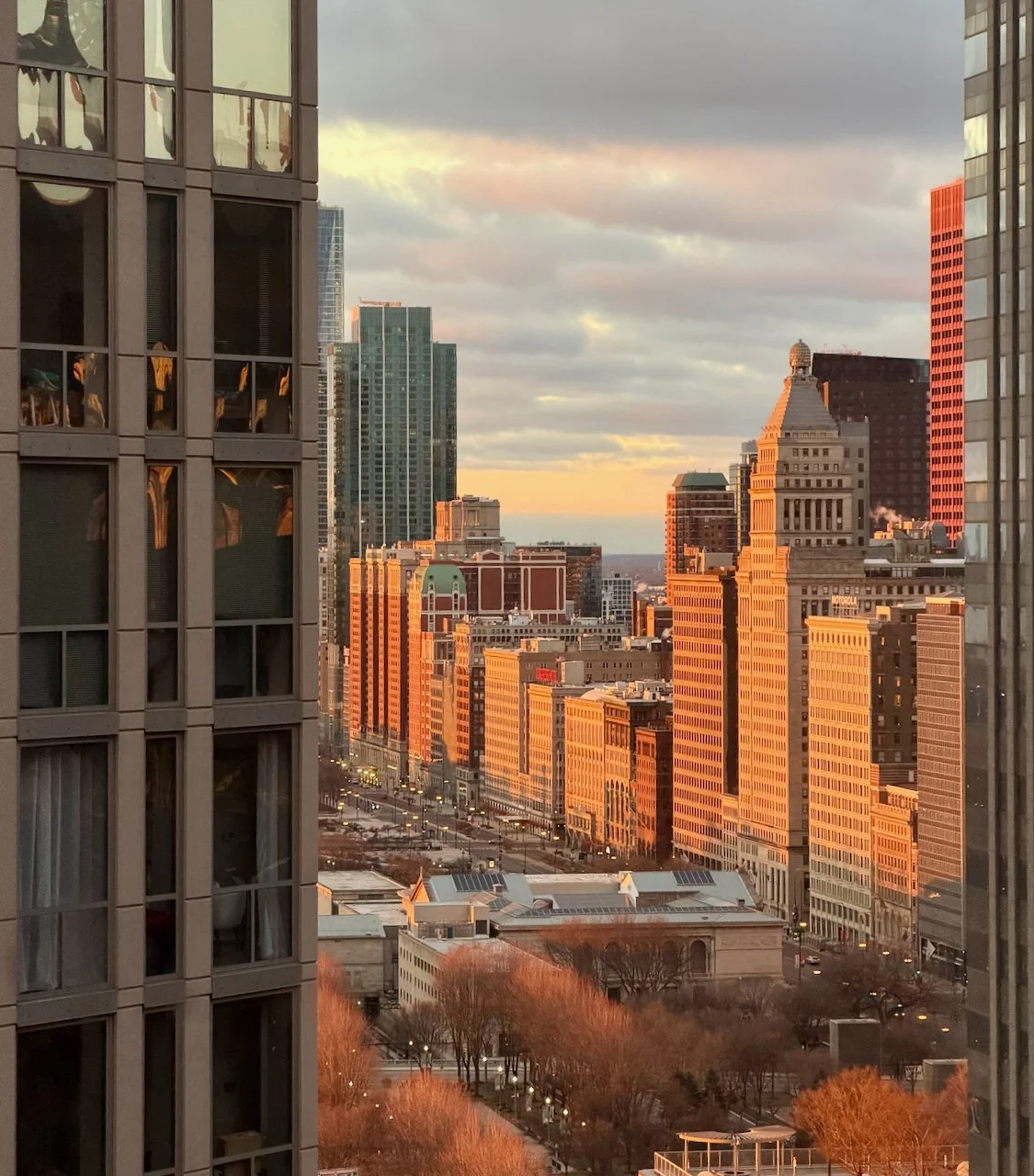
Morning in Chicago at the end of a whirlwind trip
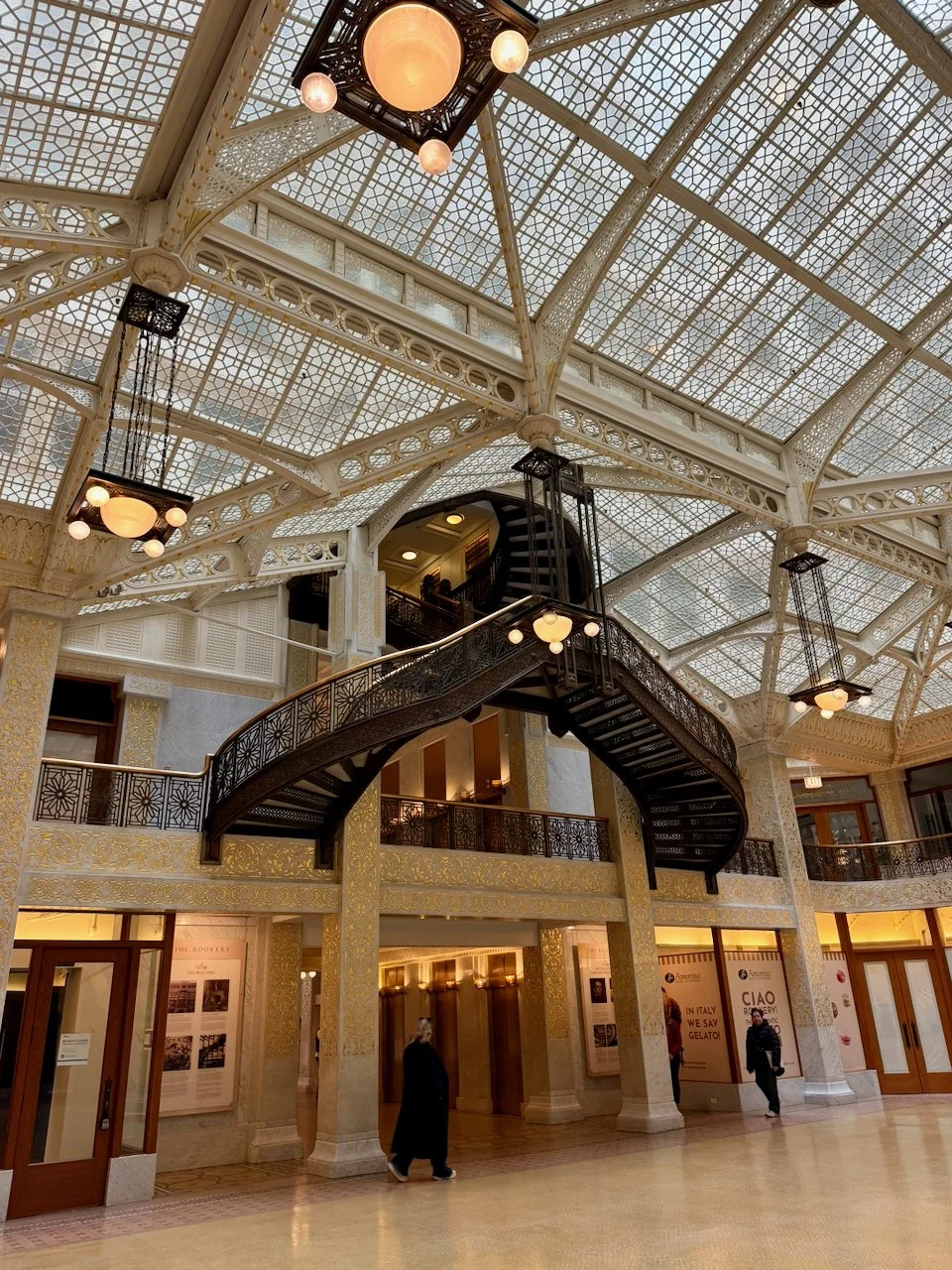
Loitering in the lobby of the Rookery; Wright in 1905 at his most fanciful. Bodacious ornament but also somehow anticipating the Johnson Wax building in the space itself?
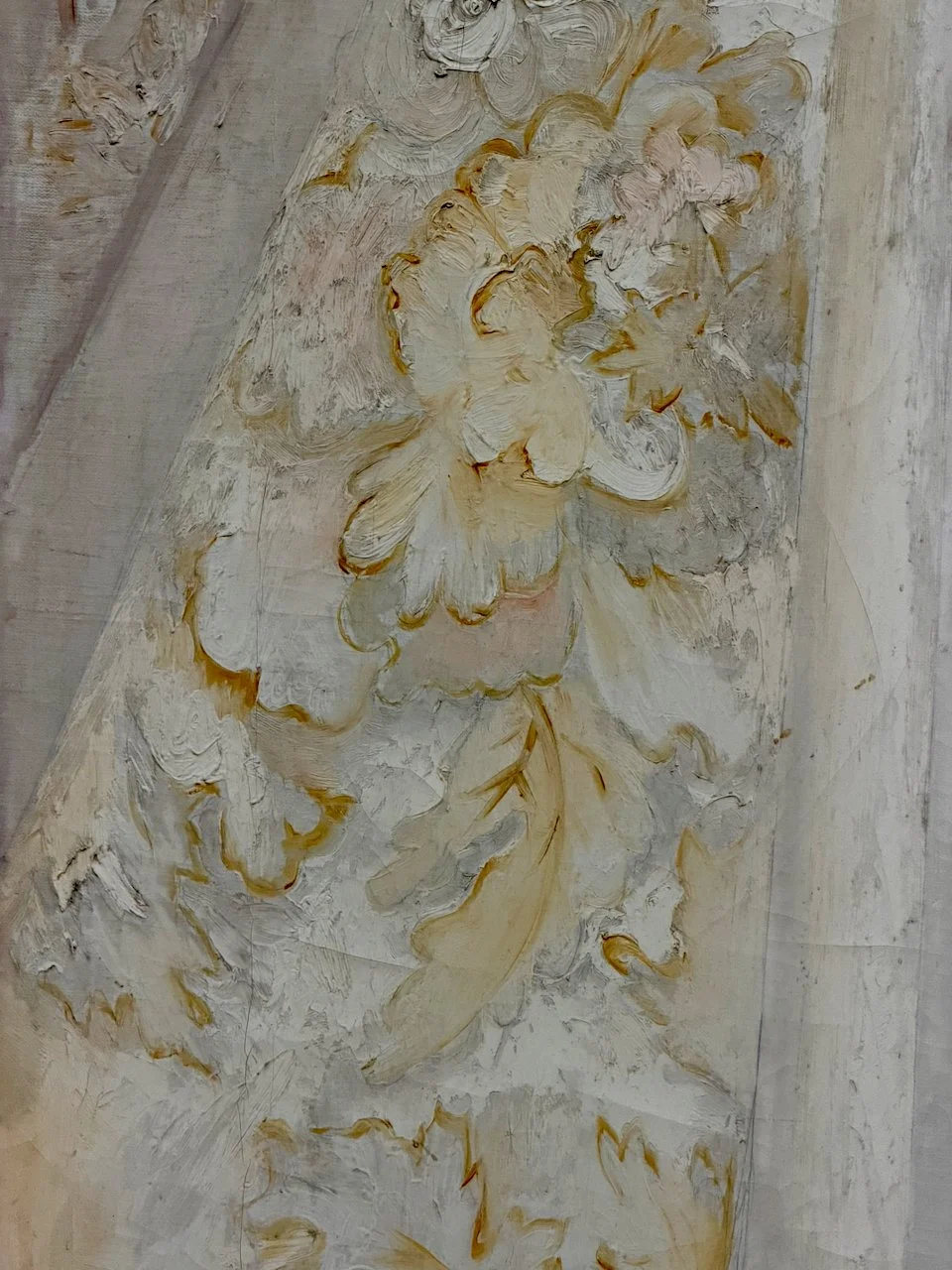
Lace detail from Natalia Goncharova’s Spanish Dancer, 1920s at the Art Institute.
Greetings from cruising altitude in the way-back section of economy.
I’m returning from a 24-hour trip to Chicago to see the Bruce Goff exhibition at the Art Institute. The slog of legislative session is over but the rapid cadence of work has not slackened. Despite the fact that my office is housed in state capitol with its truly superb collection of New Mexican art, my day job in public policy lives mostly in a windowless basement office across Excel sheets and Teams meetings. I’ve done what I can to inject a little loveliness—a coral pink lamp, a deer antler, the skeletal seed pods of last year’s giant blazingstar propped in an empty bottle of Ancho Reyes, a few O’Keeffe prints. But this can only stave off the craving—like some kind of aesthetic junkie I need a regular dose of beauty to keep myself going.
My friend Craig Lee has spent the past six years preparing for the second major retrospective of the architect Bruce Goff at the Art Institute; a project that took shape in parallel with Through the Long Desert. Craig came out to Taliesin last fall to catch my talk at Hillside Theater; I wanted to return the courtesy of coming out to Chicago for Bruce Goff: Material Worlds.
We meet in Frank Lloyd Wright’s lobby at the Rookery. On this trip I’m apparently craving ornament and lace and detail. Living in a town where sturdy, squat adobe (or faux-dobe, as is more often the case) prevails, I’m here for intricate botanicals, delicate masonry adornments, the meticulous mosaic floors. Wherever I go on this particular Saturday in Chicago there seem to be couples taking wedding pictures and I’m finding myself strangely rapt by these brides in their finery. The Rookery is in her best matrimonial attire; luminous despite the overcast day. When Wright completed this project in 1905, the architect already had an established practice in Oak Park, turning out prairie houses for well-to-do clients in Chicago and beyond. But here, Mr. Wright is bending a little Beaux-Artsy in deference to the Burnham and Root building; an homage to an earlier era and to his mentor Louis Sullivan.
Craig and I lunch in the French bistro on the ground floor of the Monadnock Building, that sturdy, voluptuous fortress of a building; a masonry office block with skyscraper aspirations. We’re both approaching middle age, questioning the wisdom of following our passions through humanities PhD programs. What did it mean to stake so much of our identities to a single, rather niche subject? To invest so many years tied to the inexorable belief in the uniqueness and value of our individual projects? To fervently believe that we could and would make a living in the humanities?
After lunch Craig walks me through Material Worlds. A lush celebration of Goff’s holistic creative practice and self expression, it takes the architect’s shimmery polyester western shirts as seriously as it does the drawings of his most well-known projects. The exhibition design for Material Worlds from New Affiliates is visually rich and playful, but never kitschy or camp. There’s a luminous warm pink that stops just shy of neon on the end walls and lining the vitrines that gives the environment a playful if slightly extraterrestrial glow. Sidestepping the trap of trying to represent absent buildings that so many architectural exhibitions fall into, the show radiates warmth and curiosity about Goff’s creative life writ large.
After seeing Goff, I’m off to the modern galleries and the arts of the Americas. There are old friends to visit—Nighthawks, the subject of a 30-page paper I wrote for my senior art history methods class. O’Keeffe’s monumental Sky Above Clouds IV floats serenely in its stairwell; I’m perpetually glad that it wound up here and not in the executive dining room of the John Deere headquarters. And there are new acquaintances, too. Magritte’s Banquet is hung in a moodily dim gallery on the third floor, the crimson orb at the center of the canvas fluorescing eerily as if anticipating the March 3 lunar eclipse. Natalia Goncharova’s Spanish Dancer (1920s) snares me too with its riot of cubist movement and luscious white lace—she clearly said yes to the dress and so did I. Elizabeth Sparhawk-Jones’s Shop Girls (c. 1912) is also an explosion of cloth, here in animated impressionist brush strokes capturing a moment in the advent of the department store. I linger until almost closing, over the protestations of aching feet and tired eyes.
This morning on the way to the airport, my cup of beauty again feels full. I imagine that this is how extroverts feel after a particularly satisfying party full of interesting and compelling social interactions. A few years ago, I would have taken the unambiguous and deeply intuitive feelings from this experience as an indication that I needed to quit my day job and get back to the cultural sector. I would have lain prostrate on the floor of my office feeling existentially bereft. I would have begun trawling LinkedIn, would have started finding the normally grating but tolerable aspects of my day job suddenly and extravagantly insupportable. I would have gone, in other words, full manic perimenopausal dream girl.
I don’t know what’s changed. Maybe it’s the vast instability of the world. Maybe it’s fact that my entire house and yard are a mess of dirt and rebar and insulation and we’re now sitting on a sizable second mortgage. Maybe it’s just that I’m almost forty and voluntary career change simply seems like too much hassle. But mostly I think it’s that I’ve figured out that this need for culture and art and beauty can be metered out, measured, micro-dosed. With some forethought and intentionality, I can step out of my daily life and into some parallel universe where my usual frame of reference recedes. I can cosplay as architecture critic or author or even just anonymous museum patron.
Because it turns out I like my day job, despite the anti-aesthetic tyranny of Microsoft Office and the incessant politicking of the Roundhouse. I value my whip-smart colleagues. Deep down, I might just be an unrelenting square who enjoys wearing navy blazers and having a pension.
Back in Santa Fe a week later, I’m mending a pair of John’s work pants, rough brown material that seems marginally more flexible than and maybe about as comfortable as burlap. It’s satisfying if taxing work, testing the limits of my Sashiko needles, and about as far as you can get from lace and tulle. It’s the kind of thing I do after the kid is down and the house is quiet; these meditative, creative tasks like mending, weaving, maybe writing the occasional Desert Dispatch.
My friend Jess, another refugee from the cultural sector, tells me a piece of advice they heard recently—that if you’re really passionate about art, you shouldn’t do it as your day job. If you do it on the margins, you own your work and no one can take it from you. So here I am, writing on the margins, in those early liminal hours before the kid wakes up, after she’s down, or in a few stolen moments over my lunch break. I know I’m privileged to have a margin to fill with creative pursuits, that there is lace to complement the canvas. At the end of the day, the existence of the fabric of daily life in all of its sturdy roughness gives meaning to the fine brocade of the extraordinary and beautiful.