Our Egos, Our Mirror Dogs, Ourselves
“How are you recovering from the ego onslaught?” my friend Sarah inquires on a recent voice memo. If there’s a better description of the process of releasing and promoting a book, I’ve yet to hear it. We all live with our egos—that Selfie McSelferson part of us convinced of our own specialness and the value of our unique contribution to the world. If it seems like suddenly everyone’s a narcissist maybe it’s because we were all narcissists all along—narcissism is a spectrum and we’re all on it somewhere. My therapist reassures me that being self-centered has been hardwired in by eons of evolution—that me-first lens keeps us focused on our personal safety and our status within the social hierarchy of our community. But certain experiences bring out these tendencies more strongly, and sometimes rather insidiously. It turns out that releasing a book is one of them. There’s nothing more intoxicating, I’ve concluded, than the kind of small-time (and I do mean small) fame that convinces you that you could be—and worse—deserve to be somebody.
I’ve been talking recently with another friend about how that early internalization of our own specialness had some assets—it’s the thing that turns the rankling adolescent declaration of “I’m getting out of this crummy little town” into manifest destiny (“crummy little town” here being a comfortable middle class upbringing in a perfectly acceptable medium-sized city). You’re getting out because you deserve it. You worked hard and you earned it but you’re also uniquely talented and you have that je ne sais quoi, that ineffable spark. I’m pretty sure that the absolute and totalizing belief in my own specialness got me into a good college with a good scholarship—when you believe the lie it’s a lot easier to sell it.
But while the conceited conviction of self-importance that drives this kind of yearning and ambition is understandable and maybe even tolerable at 18, it’s no longer palatable or sustainable at 38. My former life coach friend talks about how so many of her high-powered clients struggled to navigate the transition from hustling hard professionally to being suddenly “post ambition.” Having your sense of self tied up exclusively with your achievements and accomplishments, it turns out, is exhausting. Another friend of mine was once informed by a psychic they met on a boat that they’d have a “medium-sized life.” At the time, when this friend was in their early 20s, that felt absolutely obliterating: obscurity seemed a fate worse than real deprivation. But now, a “medium-sized life” seems not so bad, maybe even desirable. Up until last year, I had largely reconciled myself to this notion—John and I left academia, moved back to our home state, bought a house in the suburbs, and found comfortable government jobs.
Then my first book came out. Suddenly, my teenage ego was back—a bottle blond with flat-ironed hair and crippling insecurities buried deep under the armor of youthful competence and utter naivety. She rolled back into my life last fall à la Regina George from Mean Girls in her convertible. “Get in, loser,” she said, “We’re gonna be famous.”
So I’ve been spending a lot of time with my ego lately. She’s extremely demanding and very fragile. She’s trying to lose weight and fix her teeth and cultivate a social media following. She’s perpetually locking herself in her metaphorical dressing room and manufacturing some kind of midlife crisis. She’s easily seduced by flattery and charm and she’s hoarding validation like it’s toilet paper circa March 2020.
I’ve been falling into the trap of either letting teen-ego-Sarah run the show or in absolute denial of her whims, ignoring her compulsive, constant whine of “I want, I want.” Is there something between total indulgence and absolute self-abnegation? In other words, is it possible to become friends with our egos?
What I’m going to suggest, if you’ll go with me on this journey, is that we make friends with our own egos by meeting them first in other people. And hence, we arrive at the concept of the mirror dog.
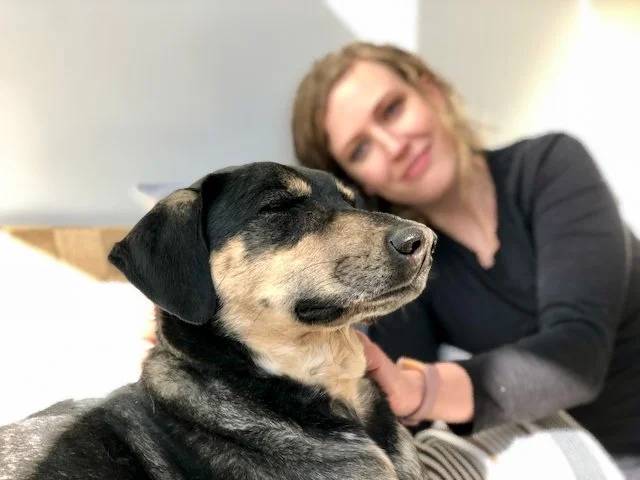
The original mirror dog
Just establishing for narrative purposes that Nessa is, in fact, the goodest girl.
Back when we lived in Ann Arbor, John and I rented a big, modern house on the edge of town. Our landlord had renovated this house—it was unapologetically his baby. He’d come over to replace the (woefully out-of-production) silver-dipped incandescent bulbs in the kitchen and would lightly comment on our furniture arrangement. Almost all of it felt of a piece—the kind of contemporary suburban refuge at home in the pages of Dwell Magazine. But the house was perhaps most endearing because of its quirks—the impossible-to-clean yellow shag carpeting on the stairs, the vintage British wallpaper on a single bedroom wall, and (critical to this story) the full-length mirror doors on the kitchen pantry. What started as a convenient feature of the house quickly morphed into a source of continual angst after we adopted Nessa, our shell-shocked rescue shepherd mix, a stray who had been scooped up off the streets of some anonymous Mississippi town and transported to Michigan on the so-called Love Waggin’. Nessa quickly realized that the mirror, behind which lurked her food and treats, was actually a window into a world inhabited by her evil doppelgänger. In Nessa’s imagined world, she and anti-Nessa competed for the same resources; each matching each other one to one for sheer ferocity and aggression. If she lunged at the mirror, mirror dog lunged right back—meeting with teeth bared at the unshakeable glass threshold between worlds.
We eventually left the house with the plywood and shag carpet and Nessa moved on. No longer confronted with a mirror near her food stash, she recovered from her aversion to reflective surfaces and found new and exciting triggers for her fear-aggression. But the term “mirror dog” remained firmly implanted in our family vocabulary.
A mirror dog is not exactly a professional nemesis or a frenemy, though it can be those things too. A mirror dog is someone you see yourself in—often the parts of yourself that are the most shadowy or problematic. In a world of limited professional and relational resources, our mirror dogs seem to be capitalizing on the things in ourselves from which we shy away. Not only are they leveraging those aspects—they are apparently profiting and thriving. My mirror dogs look back and say “Hey girl, unchecked professional ambition is really working for me!” or “I’ve made myself into a brand and it’s GREAT!” or “Maybe if you just sacrificed more, you’d be publishing in The New Yorker, too.” They’re maybe one rung up the promotion ladder or a step farther on the path toward D-list fame. They inspire a kind of indignation of pure ego: if they could do that, why can’t I? Am I not more interesting/smarter/attractive/productive? Maybe if I just worked a tiny bit harder, sidestepped a few ethical and moral qualms, I’d be there, reveling in the world on the other side of the mirror—the land where the dog treats are plentiful and the lighting is more flattering.
Critically, mirror dogs may or may not be aware of your existence; having a mirror dog can be a purely one-sided parasocial relationship. I’ve watched with fascination and no small amount of petty jealousy the career of a writer who graduated from the same undergraduate institution on the same scholarship a year before me. Her writing has a sharpness and clarity and humor that I admire. She’s photogenic to boot, with a kind of rhetorical quickness and throaty laugh that makes her an ideal podcast guest. I am quite certain, though we once exchanged a handful of emails, that she has no idea that I exist. Yet whenever I see one of her articles in print, or a glamorous profile of her trendy life, my hackles rise involuntarily.
But occasionally you get up close and personal with a mirror dog. Maybe there’s one in your office and you have to acclimate to their proximity. I’ve got fewer IRL mirror dogs now that I’m no longer in the arts or academia on the daily, but in a past life I was haunted by my peers who had gotten tenure or who had scored the sweet curatorial job at a major institution. John’s got some golf mirror dogs, guys who show up for tournaments embodying some vaguely menacing, regressive form of masculinity (suddenly back in vogue). Mirror dogs most often appear in your same gender, especially when you’re a professional woman and it feels like there’s simply not enough validation/opportunity/promotions/gigs to go aorund. But if you’re straight, there’s always the specter of the dreaded opposite-sex mirror dog, a creature who kindles the toxic twin flame of infatuation and irritation: wanting to take what your mirror dog has blurs disturbingly into just plain wanting.
Frank Lloyd Wright and Georgia O’Keeffe had mirror dogs, too, I think. For Wright, it was the architect Raymond Hood who conjured the most bristling resentment. Hood, to Wright’s mind, succeeded financially because he sold out, because he played stylistic bingo, because he kept the clients happy at the expense of making art. But really, was Hood any more than of a relentless salesman than Wright? Dubious. Georgia’s mirror dogs were maybe less professional rivals than romantic ones. Dorothy Norman leveraged her relationship with Stieglitz to gain fame and connections. But at the end of the day, hadn’t Georgia (operating at a very different echelon of talent from Norman, admittedly), done the same? How far would the schoolteacher from Wisconsin have gone without Stieglitz advocating for her? That Norman was younger and more sycophantic would have been salt in the wound but the parallels between two women would not have escaped O’Keeffe’s perceptive faculties.
The seductive thing about the mirror dog is our tendency to project our own deepest insecurities onto their successes, to make them glassy, insensate reflections of our own megalomania. But at the end of the day, the mirror dog is a mental device beneath which lurks a human being with their own pain and insecurities and aspirations. Some of them are putting beautiful art out into the world, however else we may judge or deride them in a bid for ill-won moral superiority. I can’t claim to have conquered my own mental habits of dwelling on the successes of others or fixating on their perceived personality flaws, but recognizing that my simmering jealousy is really, deep down, terror at my own unshakeable selfishness, is perhaps a step in the right direction. I often find it easier to have empathy for my mirror dogs than it is to for the analogous parts of myself.
I call John after giving a talk at Cranbrook. It was an endowed lecture; the first I’ve given. The auditorium was packed; the audience laughed and gasped in all the right places. Afterwards, I signed books and then was whisked off to Cranbrook House to be plied with prosecco and sign still more books before a catered three-course meal. John asks how it was. I reply that it was wonderful but that I’m still metabolizing it. It was a lot, I tell him, to be seated at the center of the table and the center of attention. “Too bad you hate that kind of thing,” he says. I’ll take the sarcasm; I’ve made some poor choices when ego-Sarah is in the driver’s seat. And this evening was the ego equivalent of drinking a whole bottle of the aforementioned prosecco in one go. But tonight I lock my hotel room door and just pass out. The ego onslaught is not over but maybe it’s something I’m learning to live with.