In Praise of the Arbitrary Stupid Goal
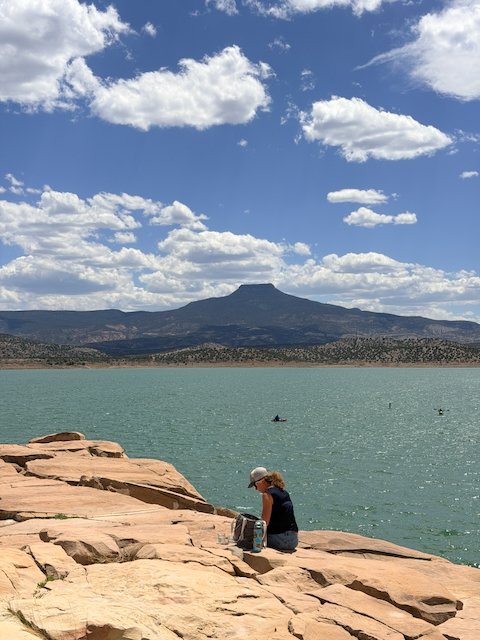
Watercoloring at Abiquiu Lake, early June
I’ve spent the last month reading, weaving, picking up watercolor again, writing a few things mostly for my own edification. My friend Rachel and I bopped up to Abiquiu one wanton Monday afternoon, and I painted at Abiquiu Lake though the wind was fierce. The lake was this surreal aqua blue I associate with the French Riviera, strangely out of place in Northern New Mexico. In the distance hovered the mysterious, brooding silhouette of the Cerro Pedernal. My life has been a lot of spreadsheets and political maneuvering over the last few months. So it was bracing and revivifying to be slapped in the face by beauty; to feel absolutely alive, wrapt in the pure eros of it all.
I think this is what I meant when I wrote about process at the beginning of the year, this doing of things not for the end result but for the unfolding experience. But even organic process sometimes needs a structure, and that is where the arbitrary stupid goal comes in.
It’s true that people (also institutions, organizations, countries) need big, hairy, ambitious goals (BHAGs). Those are the things that define the arc of your decade, that provide that critical thrum of purpose that quickens the pulse and gets you out of bed in the morning to do the thing. These might be things like putting a human on the moon or reaching carbon net zero or, on the ridiculously small and perhaps ill-advised scale, deciding to get a humanities PhD. We can’t do BHAGs all the time. They are meaningful but exhausting. Arbitrary stupid goals (ASGs) are not that.(1) They are lightly structured doing for the sake of doing.
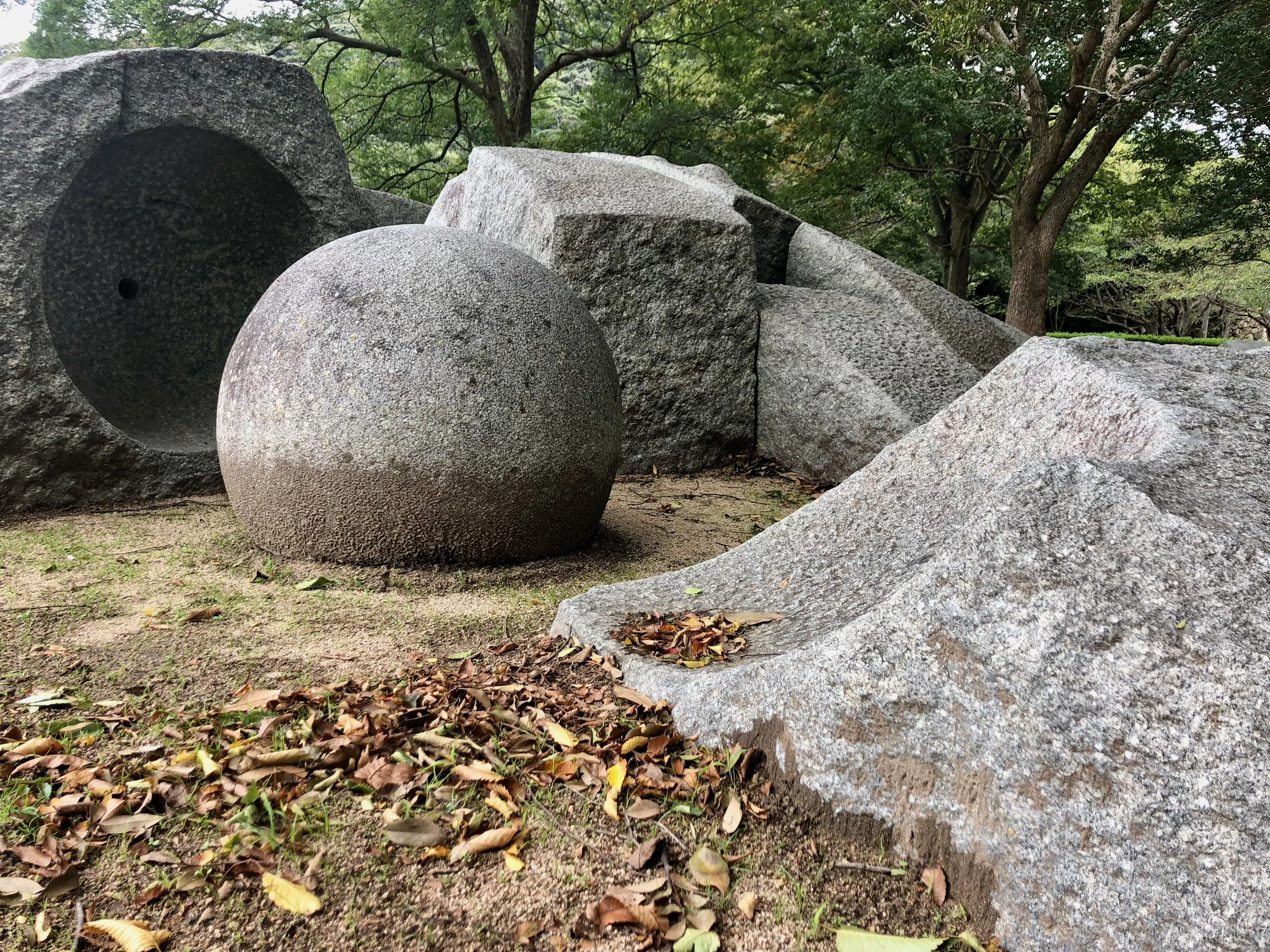
We never figured out who made these amazing sculptures in Hagi, Japan (2018)
The ASG has become a lifesaver for me and John when it comes to travel. Critically, the ASG removes the pressure to have a good time or to relax. This explains, in part, why we legitimately had a better time touring Meiji-era industrial UNESCO sites in remote regions of Japan than we did in Tulum at an all-inclusive adults only beachside resort. When the goal is merely to reach the Hagi Reverberatory Furnace, there are no expectations. Sipping endless strawberry margaritas on perfectly white sand, I expected to be delighted, to be enthralled, to be in a constant state of relaxation and frivolous exuberance. It stressed me out when I wasn’t. Meanwhile in Hagi, we had no expectations. We weren’t expecting to find an unnamed modern sculpture park hidden behind a set of centuries-old castle ruins. We weren’t secretly hoping to stumble into a mostly abandoned 1980s shopping arcade and find a quaint Italian joint where the proprietor served his daughter at the bar while she did her homework and we ate pasta with tomato sauce for the first time in two months. The warm typhoon winds did not perturb us because we had not come to be comfortable. We came to see a reverberatory furnace. Mission accomplished.
Several years and a five-year-old child later, we are still comically bad at relaxing on command (see the aforementioned Mexican resort vacation). So we’re making an effort to reclaim the ASG as a practice.
Recently on a late night YouTube trawl (late night in late-30s parent-adjusted terms, so probably 9 pm), John and I stumbled across a video that has been making the millennial internet rounds. In it a couple, relatively well known in outdoorsy circles, hikes across the diameter of Los Angeles, traversing 37 miles in a single day. Along the way from mountain to beach, there are musings about the water system, the L.A. food scene, and hiking while in pain. As in so many other depictions of Los Angeles, the city is really a character unto itself; a shifting, shimmering miasma of American dreams hardened into the arteries of freeways and skeletons of strip malls. I’m thinking here of the rambling cinematic sprawl of Los Angeles Plays Itself (2003), of Joan Didion’s rumbling, glittering, apocalyptic essays, and Ed Ruscha’s encyclopedic Every Building on the Sunset Strip (1966).
And of course, I thought of Reyner Banham’s Los Angeles: Architecture of the Four Ecologies (1971), whose whole conceit is that L.A. is an autopia and should be experienced as a kind of driving tour. Banham writes, “Whether you regard them as crowns of thorns or chaplets of laurels, the freeways are what the tutelary deity of the City of Angels should wear upon her head instead of the mural crowns sported by civic goddesses of old.” The critic would go on the following year to make a delightful film called Reyner Banham Loves Los Angeles(technologically prescient; though the views on race and class have not held up). While Banham periodically disembarks to take in various monuments and landmarks, most shots of the film are about the uniquely automotive experience of Los Angeles and its built environment. Do yourself a favor and just watch the first five minutes to get a flavor of it.
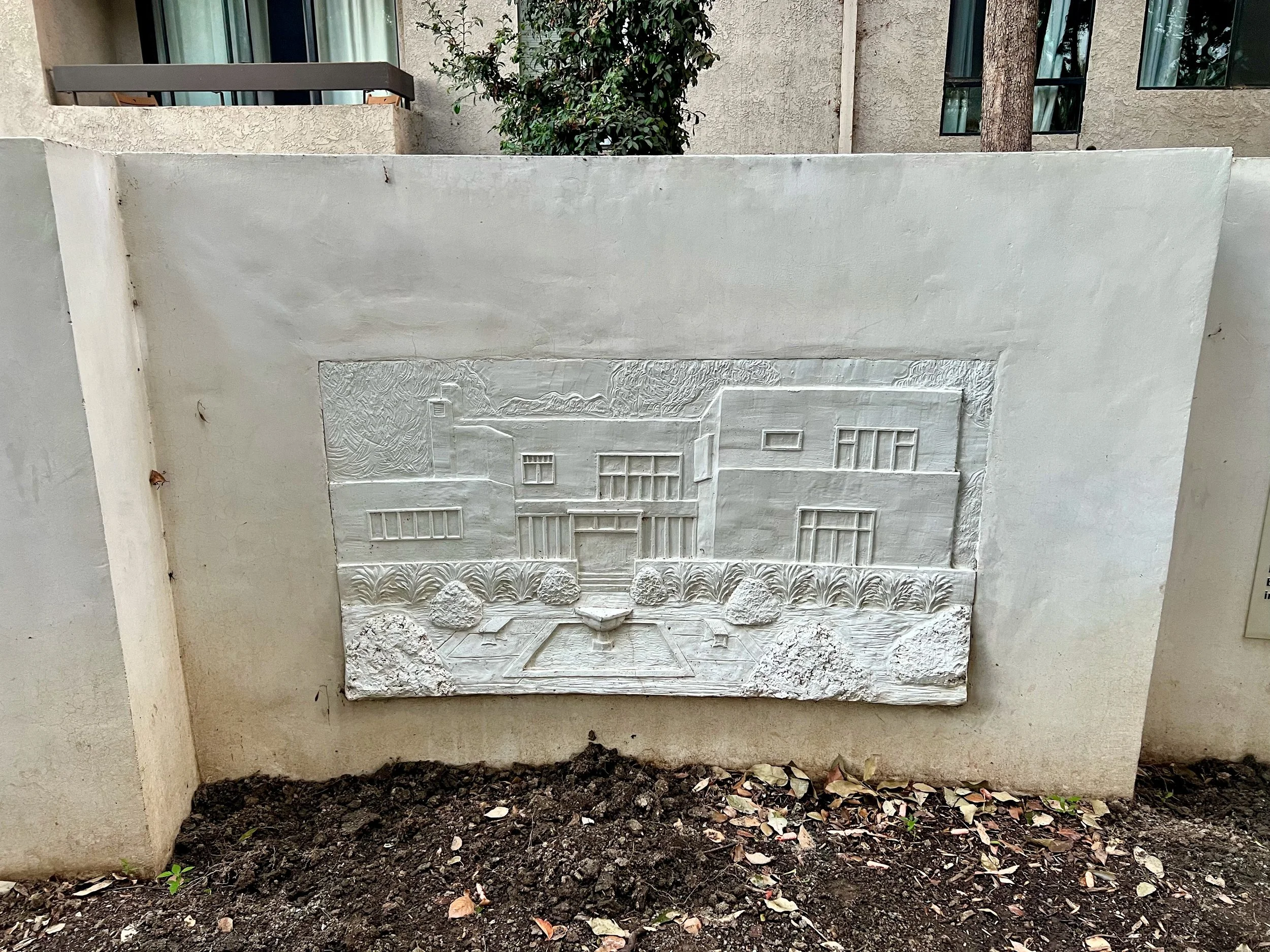
The Los Angeles memorial for architect Irving Gill’s modernist masterpiece, the Walter L. Dodge House (completed 1916, demolished 1970).
So, what does it mean to turn the fundamental conceit of Los Angeles on its head? To subvert the expectation of America’s ultimate driving city by traveling the entirety of its east to west trajectory on foot? It made me think of my own most recent research trip to L.A. in 2024 when I refused to rent a car and instead engineered my own walking tour through West Hollywood. Trucking around in my Chacos and Patagonia hat like I had just rolled out of an REI ad, I bought some expensive lingerie on Santa Monica Blvd, visited the Walter Luther Dodge House site on Kings Road, and devoured a plate of mediocre pasta among very attractive and fashionable people. It was hardly a 37-mile thru-hike, but I would have missed so much that night from a car—the profusion of film set-worthy Halloween decorations, the couple wearing togas while grocery shopping, the outrageous citywide eruption of joy when the Dodgers won the World Series.
But to walk across an entire city, merely for the experience (and potentially the bragging rights)? Perhaps akin to the Portlandia sketch “We can pickle that,” with its perky absurdity, can-do attitude, and seemingly willful sidestepping of white privilege, there’s something unique to a particular class and age of people, to whom this idea would appeal.
As we are squarely in that demographic, John and I hatched a plan to thru-hike Santa Fe, starting at Ten Thousand Waves and ending at the Santa Fe Brewing headquarters. Santa Fe is unsurprisingly smaller than Los Angeles, so we were looking at a 15 mile walk, mostly downhill. We made the plans, picked a day, lined up childcare. Originally, this newsletter was going to document our day of walking, capped by tacos and a beer and surrounded by family and friends.
(1) There is a memoir by Tamara Shopsin of this same name. I have not read it and am not entirely sure where John and I picked up the phrase, but it’s been something we’ve referred to frequently for the past decade.
We Didn’t Do the Thing
Then… John dropped a (mercifully unloaded) 20 kg barbell on his ankle earlier this week and I tweaked my back starting a new weightlifting program. On the home renovation front, we accidentally picked a stucco for our house that turned out to be a violent shade of periwinkle, necessitating a rather speedy pivot. Plus there’s intermittent smoke blowing through town from a few nearby fires, and it’s over 90 Fahrenheit today with scant cloud cover. So, we didn’t do the thing.
But that’s the other magical thing about the arbitrary stupid goal. If you don’t do it, it’s okay. Sure, it might be disappointing that the thing didn’t happen. I remember missing a half marathon in grad school due to some gnarly respiratory infection and feeling massively bummed out. But did it kill me to miss that race? Did it fundamentally shift my perception of myself and my abilities? No.
Our thru-hike of Santa Fe will keep. It’s still a good idea. But maybe it makes more sense when the weather’s cooler, when we’re not injured, when our construction is finished. Instead, we ended up doing the things we probably needed to do anyway; going for a morning walk with the dog before the temperature ticked too far up, sending off a passel of returns, and refreshing our camping gear. And that is another benefit of the ASG; its ability to be abandoned without breaking anything.
So look for another newsletter come autumn, with a long and meandering hike through the City Different. We’ll take you down the mountain, through the Plaza, over the arroyos. Maybe if you’re in Santa Fe you can even join us for that celebratory beer at the end.