Process, Play, and the Unrealized Dream
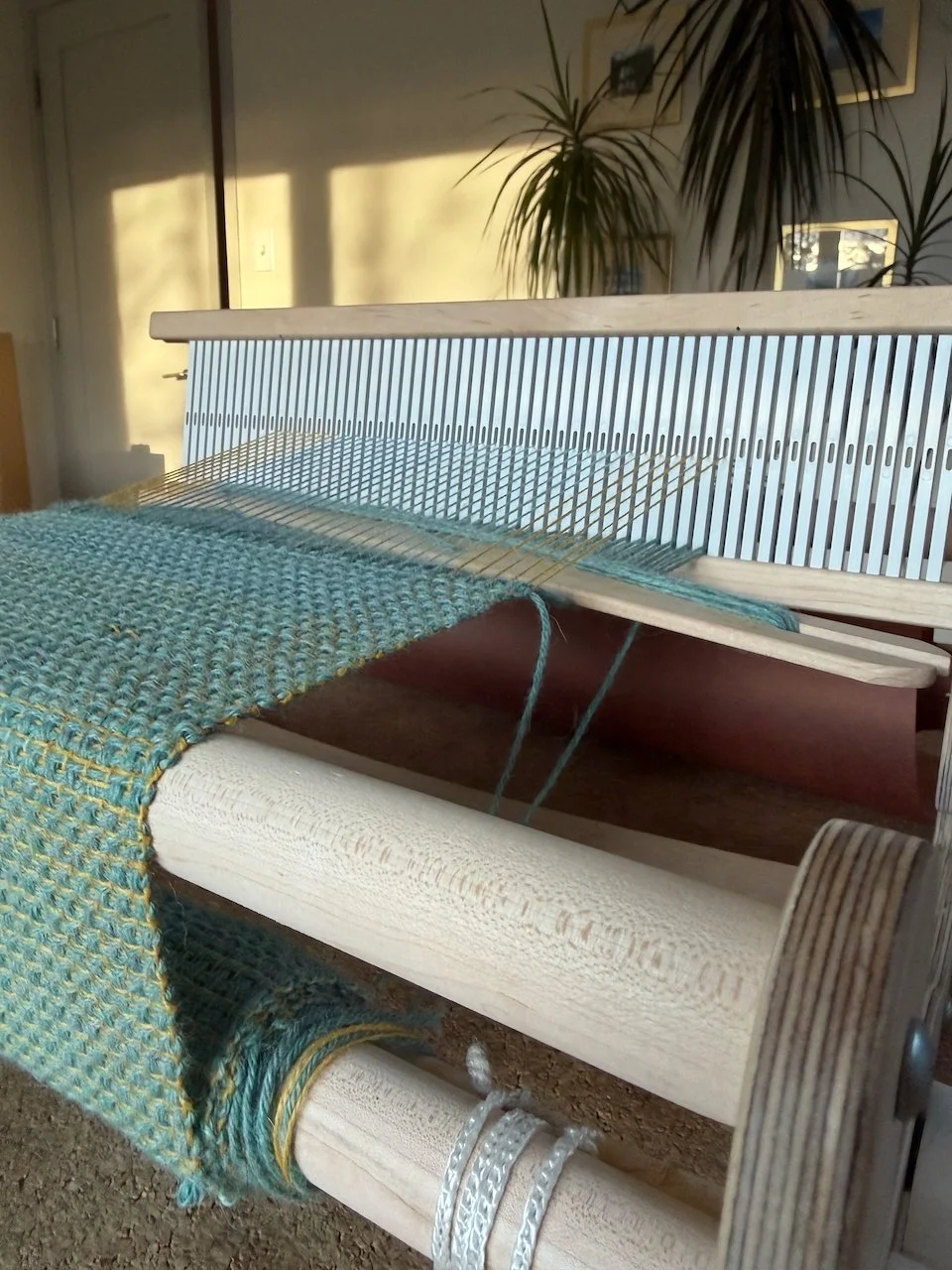
I started weaving last year. I’m not very good yet but it’s about the practice.
Happy New Year, readers. So, do you have any resolutions?
No, no, I’m not being snide. Certainly, my twenties and early thirties were marked by a deep suspicion of and even cynicism towards resolutions and any number of other seemingly arbitrary, time-boxed rituals (Dry January is just early Lent, right? And No-Shave November seems a flimsy excuse to neglect personal grooming.). But something about the incessant creep towards forty though has got me backtracking, suddenly finding comfort and even usefulness these kinds of gestures. This year I participated in coach Molly Mahar’s Holiday Council, a three-week opportunity to reflect on the past year and to set goals and visions for the coming one. The whole thing is more structured and intentional than a list of resolutions, but still hinges on the idea that there is something conceptually and culturally sticky about the turning of the calendar year.
The reflections of Holiday Council helped me to recognize that I’ve been hustling hard, prioritizing ambition and accomplishment for the last several years. I’ve been treating writing/career/family/partnership as a zero-sum game of my limited time and attention. And I’ve been driving towards success (almost always defined through external metrics) for so long that I have forgotten why any of this matters in the first place. I wrote a book because I felt like I had something important and new to say, BUT ALSO because I wanted to be the kind of person who has written a book. Ditto for any number of other lines on the CV; Ph.D., summa cum laude, valedictorian. There’s an ego-driven vacuousness to it all that I can’t quite shake. What would I have done with my life if not shackled to the overwhelming compulsion to seem impressive?
So this year? My big goal is to STOP accomplishing and get back to the WHY underneath. I’m not going to stop making, doing, creating but I’m going to stop attaching deadlines, end products, and benchmarks to these things. I’m embracing this as a season of reorientation rather than striving toward the next big thing. I’m opting for steadiness and sustainable creative practices over performative outcomes. The doing itself is the goal. In other words, 2026 is the year of process over product.
Back in 2018, I received the H. Allen Brooks Traveling Fellowship from the Society of Architectural Historians. In the vein of those Grand Tours of yore when moneyed British lads sojourned to France and Italy to gain an education through travel, the Brooks Fellowship explicitly stipulates that its recipients are NOT to be working on a book project. The goal is to show up, be fully present, do a little writing, but avoid spending weeks mired in archives or cloistered in an AirBnB producing a manuscript. Barred from producing a scholarly monograph, I sank my teeth into what in retrospect feels like a truly absurd number of self-assigned writing projects. The only explicit requirements of the fellowship were a monthly blog post for the Society of Architectural Historians and the contribution of 500 photographs to the Society’s image database—really not a lot given the scope of a year. Being under-constrained created room for play, and play I did. I produced a daily Instagram post, a newsletter (maybe the progenitor of the one you’re reading now?), and a weekly podcast with my husband, John. The podcast in particular was far outside of my comfort zone; I was unaccustomed to producing audio and the learning curve was steep. Despite the thorny logistics of traveling across fourteen countries on five continents and the considerable time spent sleeping off jet lag in assorted hostels, it was the most productive creative year of my life to date.
In 2026, I’m not exactly under-constrained. There’s a precocious preschooler, a demanding day job, an impending home construction project. But I’m trying to recapture some of that same capacity for experimentation that I found on the Brooks. In that spirit, I’m making a little foray into historical fiction. I have about as much confidence in my capacity as a fiction writer as I did in my ability as a podcast producer, but I’m giving it a shot nevertheless. Per my agreement with myself, I’m not trying to produce a novel this year (No-Shave November seems much more attainable than the contemporaneous National Novel Writing Month). But I’m showing up (humbly) for my characters on a regular basis, nurturing a genuine curiosity about who they are and what they get up to.
As I try something new, wildly uncertain about the outcomes, I’ve been thinking about O’Keeffe and Wright. It’s easy to look at their canons and see two creatives who were wildly productive and successful over many decades, measured both by total output and by average overall quality of work. Yet both of them had really big, gnarly, ambitious goals that ultimately went unrealized, or at least didn’t end up taking the form that either of them had initially imagined.
O’Keeffe’s proverbial white whale was to create an architecturally-specific mural. It was a dream that she chased for decades and that always seemed to elude her grasp. There was the ill-fated Radio City Music Hall commission in 1932—a project so technically disastrous and personally fraught that O’Keeffe suffered a mental breakdown in the aftermath. That setback didn’t stop her from trying to get other mural commissions, however—she wrote to well-connected friends and even made a pitch to a museum in Santa Fe. Starting in the early 1940s, she painted bigger, more complex canvases that seemed to gesture at her untapped potential as a muralist. In 1964, her friend Alexander Girard proposed the idea of her doing two monumental, site-specific paintings for the new John Deere headquarters in Moline, Illinois. Though that project again fell apart, it led to the monumental Sky Above Clouds IV, an 8 by 24 foot canvas that the artist painted in her Ghost Ranch garage during the summer of 1965. Sky Above Clouds IV now hangs at the Art Institute of Chicago, a monument to O’Keeffe’s compelling but ultimately unrealized vision.
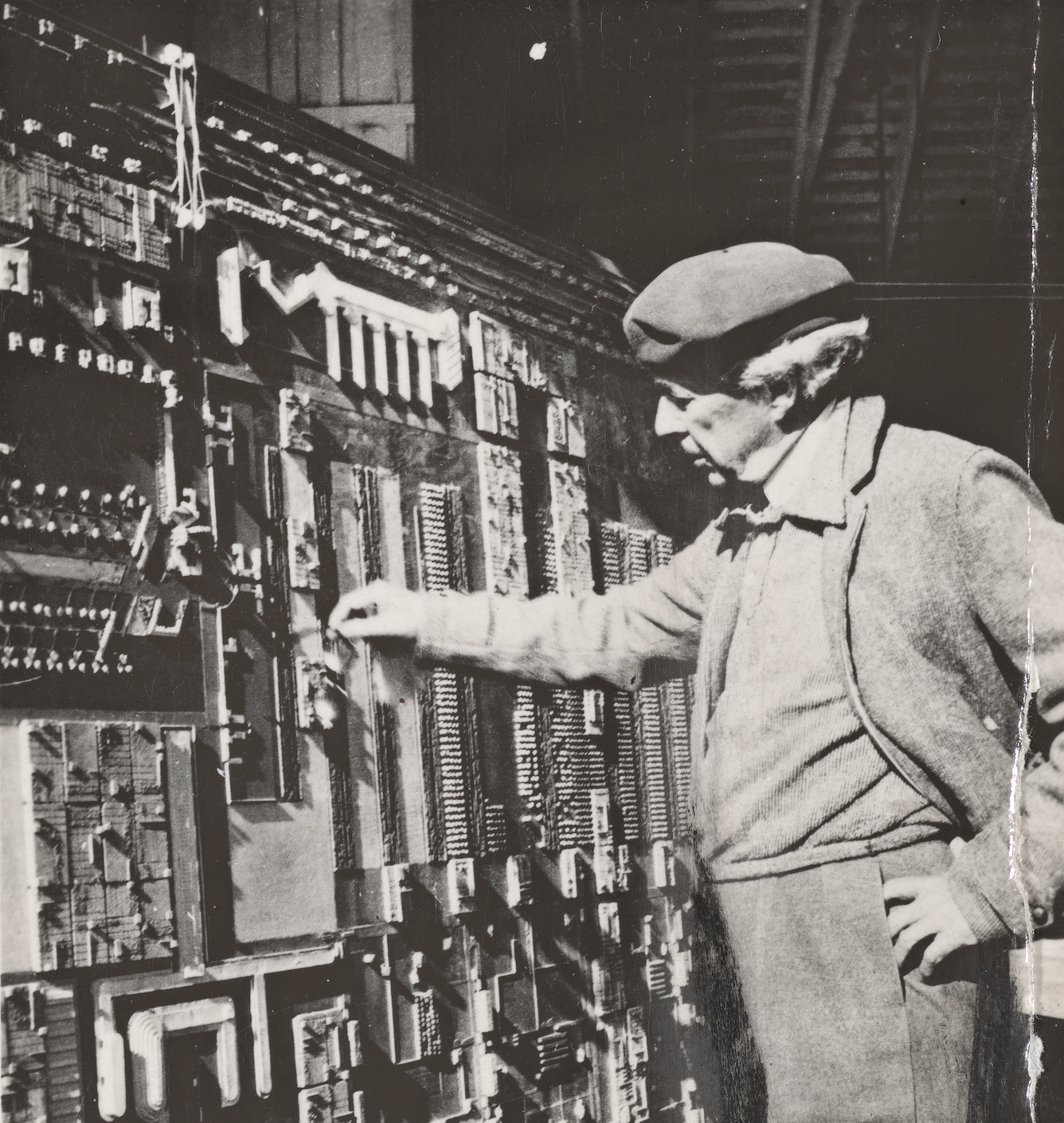
Frank Lloyd Wright inspecting the Broadacre City relief model, 1935. The Frank Lloyd Wright Foundation Archives (The Museum of Modern Art | Avery Architectural & Fine Arts Library, Columbia University, New York), 3407.0056
For Wright, it was the dream of Broadacre City. In the 1920s, Wright and his apprentices started working on the plan for Broadacre City—a decentralized model of American urbanism in which every family would have roughly an acre of land. High-speed automobiles would provide rapid transit and electrified technology would enable instantaneous communication and access to culture. Wright first fleshed out the idea in detail in the 1932 book The Disappearing City. In 1934, he worked with his apprentices to produce a 12’ by 12’ model that was first displayed in New York in 1935 (though he would continue to tinker with it until his death). Wright even put together a petition during World War II asking the U.S. government to fund the work. Many intellectuals, celebrities, and luminaries signed on (O’Keeffe, of course, but also the likes of Albert Einstein and Robert Moses). Though he failed to garner the government buy-in he hoped for, the work persisted and Broadacre became a kind of intellectual provocation that continued to generate new ideas and influence designs for the rest of Wright’s career. Many pivotal works from Wright’s late career, including the Marin County Civic Center and the Price Tower, have their roots in ideas about democracy and the built environment originally developed through the Broadacre City work.
Wright and O’Keeffe’s grand visions, though they never really came to fruition, undoubtedly pushed their practices forward. I think of all the astonishing paintings that O’Keeffe created as she was dreaming of and working towards the mural that would never be, and for Wright, all of the projects created as part of Broadacre City that would find new life in other, constructed projects.
So I’m not married to publishing a novel. But I feel a deep certainty that at least making a sustained effort in the field of fiction will strengthen my skills at a non-fiction writer. At the end of the day, it’s all stories.