Taliesin: A Walk on Borrowed Time
Driving back down highway 61 to the Quad Cities from Dubuque, an unwieldy truck (ostensibly toting a load of granite??) for “Iowa Heritage Monuments” clipped past me going about 80 MPH. I thought of Emily Dickinson’s verse:
“Because I could not stop for Death –
He kindly stopped for me –
The Carriage held but just Ourselves –
And Immortality.”
But this death wasn’t stopping. This was white-knuckled death on a mission. I guess now even death moves at the lather-rinse-repeat pace of late-stage capitalism.
Maybe it just struck me funny given the tempo at which things move at Taliesin.
I’m staying at Tan-Y-Deri, the house that Frank Lloyd Frank Lloyd Wright designed for his sister, Jane, in 1907. According to our tour guide, Jane just wanted a regular old foursquare farmhouse and Wright acquiesced to her request, however grudgingly. Tan-Y-Deri, which means “under the oaks” in Welsh, is as snug and unpretentious as I remember my grandparents’ farm house being in northeast Iowa. Wright lets nature be the spectacle here—the back porch proffers a sweeping panorama of the Valley. At the center of that view is Taliesin, that shining brow upon the hill — which Wright would start building for himself and his partner, Mamah Borthwick Cheney, in 1911. Thirty-six hours in the valley would unfold from Tan-Y-Deri’s warm, deep brown walls: sprawling walks in borrowed boots, the unexpected confluence of new and old friends.
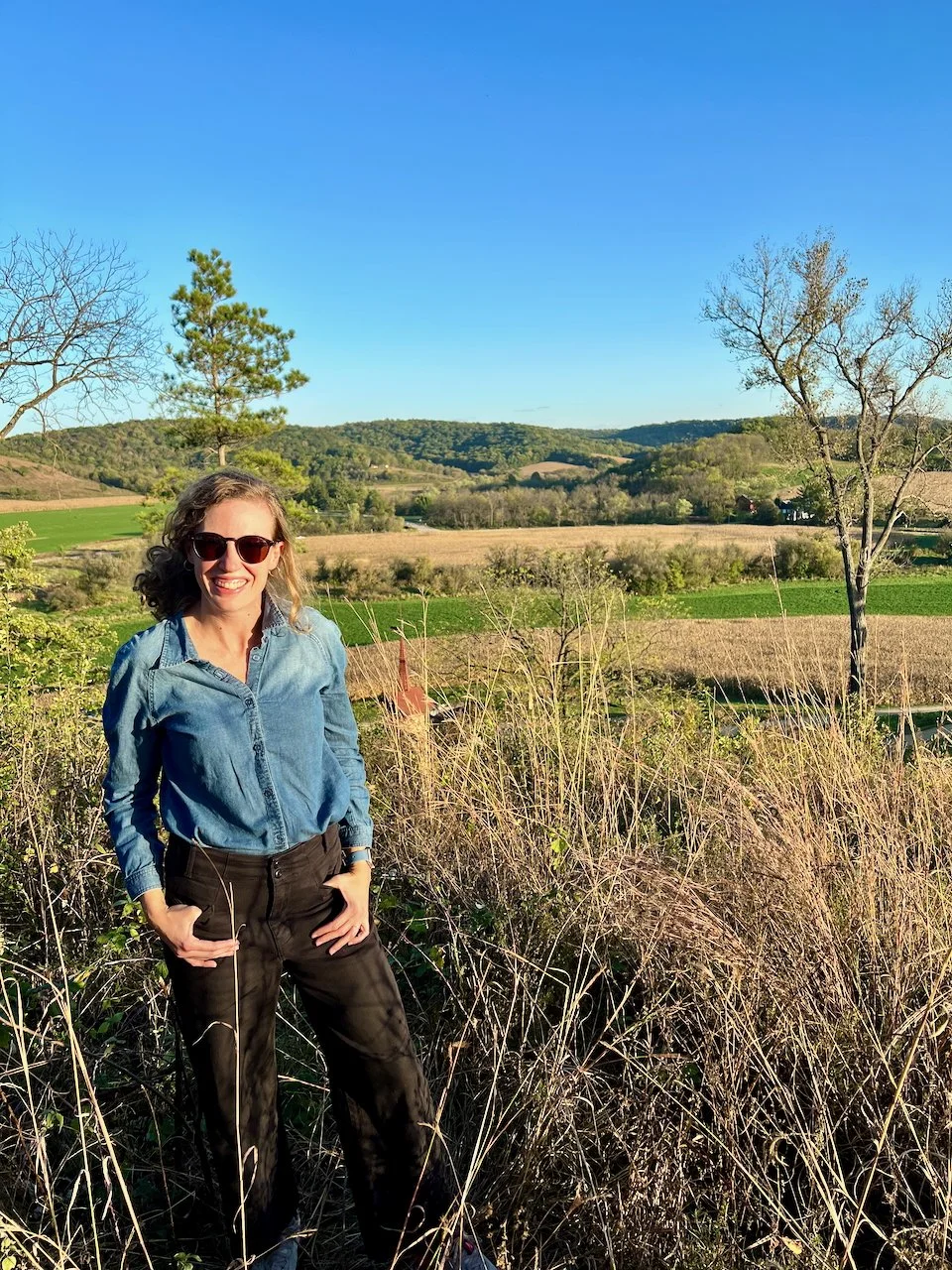
Slightly disheveled on top of Midway Hill. Mind the poison ivy on your way up.
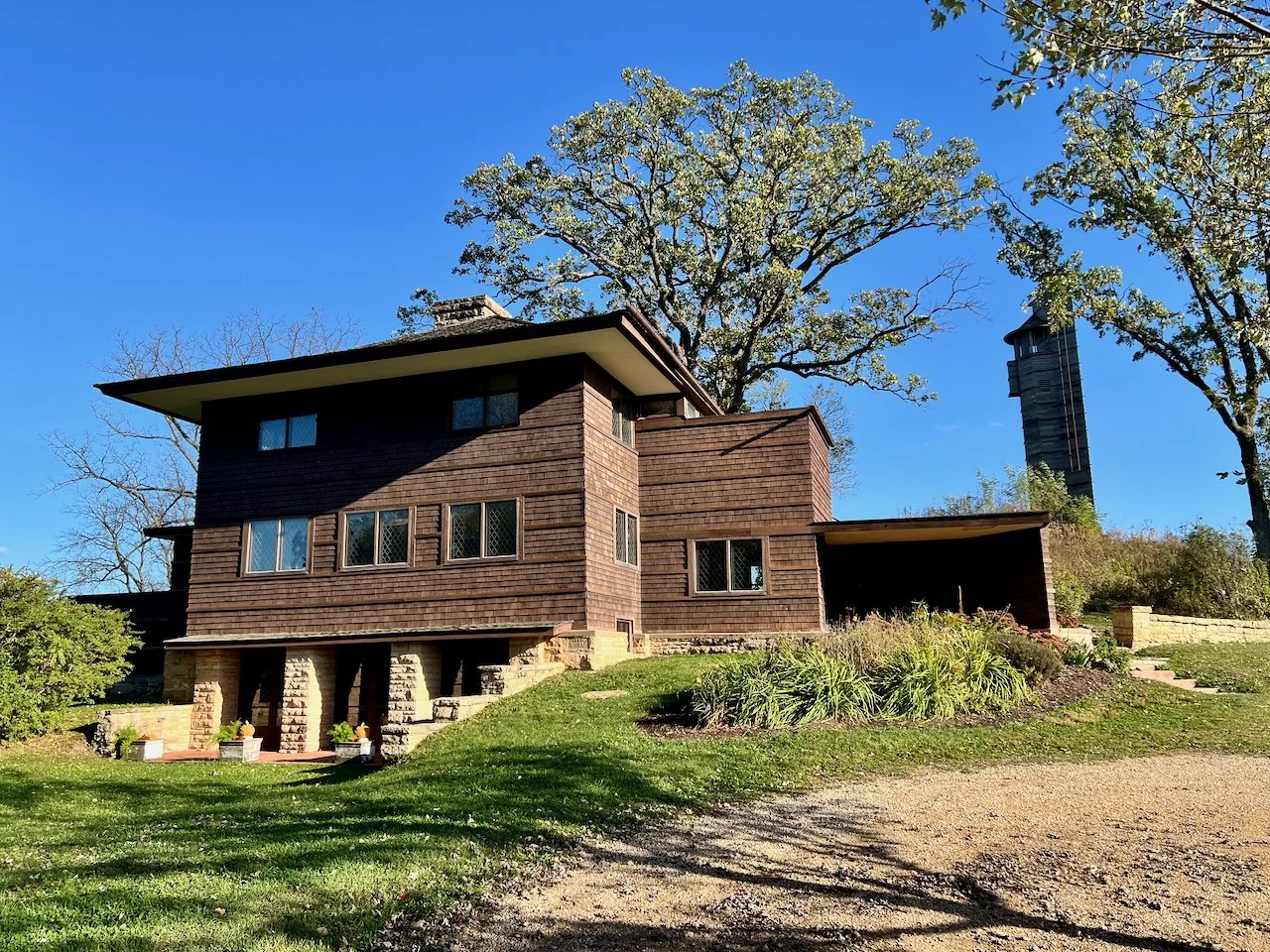
Frank Lloyd Wright doing the cottage-core four-square farmhouse. The Folklore of the Wright Eras Tour???
This is the first time I’ve been back to Taliesin since my first visit in March 2023. When I visited then, the ground was still frozen and Wright’s outdoor sculptures were still housed in their plywood boxes to protect them from the weather. The groundskeepers and stewards were busy getting the ready for tour season but outside work hours the campus seems to hold its breath as though all of nature was poised waiting for the onset of spring.
This year, autumn has come late and the trees are still mostly green, punctuated by the occasional glint of gold or crimson. The tour season is wrapping up but visitors still file through the house, gasping at the murders (maybe read the Wikipedia page first?) and knocking their brows on the low thresholds. I’m here to give a talk, “Frank Lloyd Wright and Georgia O’Keeffe: Imagining Midwestern Landscapes,” at Hillside Theater. The audience laughs in the right places; I’ve dredged up some of my excised material on barns for the occasion. There’s a signing afterwards and I’ve gotten down my standard inscription (“My best wishes for your own trip through the long desert, wherever your journey takes you”) though a few patrons invariably ask for something a little different. This time someone requests a string of the first words that spring to my head in rapid succession, which include “cloud,” “sensate,” and “diligent.” Freudians and Jungians, I welcome your interpretations.
And now I’m out past my bedtime. There’s a waning gibbous moon cresting what Wright dubbed the Welsh Hills. My socks are soaked, my feet are freezing, but I feel vividly attuned to the steady pulse of the valley. There is the thrum of nature; low and reassuring. It is in the smell of the wet clover, in the steadiness of the damp earth beneath. It is in the rustle of unseen creatures through the dense brown cornfields ready for harvest. It is in the glimmer (imagined?) of the last lightning bug of the season. It is even in the inelegant passage of a flock of gamboling wild turkeys. And despite its profusion, vast and overgrown in the late comer autumn, this thin scrabbling crust of ephemeral life is merely clinging to the lower register of geological time. But all those limestone escarpments, spared by the last ice age, pale beneath the lowest, omnipresent hum of the stars and planets in their clines.
And then at some higher frequency, there is the overtone of human touch upon this valley. If you don’t listen closely, there is only the present; the fog of breath and the sound of footsteps in the dark. But the human past is there too… persistently picking out its own half-remembered melody. The moonlight is insufficient to render legible the gravestones in the Lloyd Jones family cemetery; iPhone flashlights are produced to augment that salt-licked silvery moon glow. My heart catches at the sight of Mamah’s grave. I wasn’t expecting it to be so wrenching—not the lurid tragedy of it but the sweetness. The stone is new, recently replaced. But it’s not about the stone, which can only gesture impotently at a name and dates. I’m not even sure that it’s her molecules now subsumed and become one with the pine growing above her. At that moment I can only half recall the stage manager’s speech from the third act of Thornton Wilder’s Our Town:
“Now there are some things we all know, but we don't take'm out and look at'm very often. We all know that something is eternal…everybody knows in their bones that something is eternal, and that something has to do with human beings. There's something way down deep that's eternal about every human being.”
Our shrink-wrapped postmodern world not only makes it easy to avoid taking these things out and looking at them, but is itself the con man whose sleight of hand keeps us ever focused on the infinite now. Death is distanced and sanitized into fast-traveling “heritage monuments.” Our entire built and digital environment is staged as a series of endless distractions, advertisements, a yawning, scrolling spiral; some sort of inverted momento mori become merely a succession of moments perpetually denying the inevitability of death.
At Taliesin, the ephemeral nature of life sits heavily on the land like the fog that mantels the Welsh Hills each morning. I learn how the brush is burned from the creeks and how to estimate the age of the trees; that even the massive, seemingly permanent weeping willow looming over the pond is maybe younger than I am.
Wright, a lifelong Unitarian, and believer in the ineffable and transcendent aspects of nature and human beings, also had the following motto installed prominently above the entrance of Taliesin’s drafting studio: “What a man does that he has.” Wright perhaps at his most existentialist? Are we any more than the sum total of our actions during our short, fragile existence? I’m not sure, but standing among the bones of the Lloyd Jones clan, the continuity and essential dignity of human existence clings to the land like dew.
The following morning, the sun is rising over the Welsh Hills despite my internal protestations. My east-facing window would only suit a neurotic early riser, with farm blood in her veins to boot. Wright, like many of his modernist contemporaries, was a hater of all window treatments. So by virtue of constitution and design, I’m up with the sun.
At least I’m in good company. As Aldo Leopold writes in A Sand County Almanac:
“Orion must have been the original mentor of the too-early company, for it is he who signals for too-early rising. It is time when Orion has passed west of the zenith about as far as one should lead a teal. Easily risers feel at ease with each other, perhaps because, unlike those who sleep late, they are given to understatement of their own achievements. Orion, the most widely traveled, says literally nothing. The coffee pot, from its first soft gurgle, underclaims the virtues of what simmers within.”
I can’t claim that the Mr. Coffee in Tan-Y-Deri’s basement kitchen concealed any great virtue, but it got me out of bed, and its brew tasted passable when paired with blueberry pie. I’m due in Dubuque that afternoon, where I’ll talk to a sparse but passionate audience. The following days go by in a blur of billboards and bookstores and blue Sharpie signatures and then somehow I’m on a plane back to Santa Fe. I’m there just long enough to reconnect with the family, to tie up some loose ends on a work project (yeah, day job persists behind all this), and repack my suitcase.
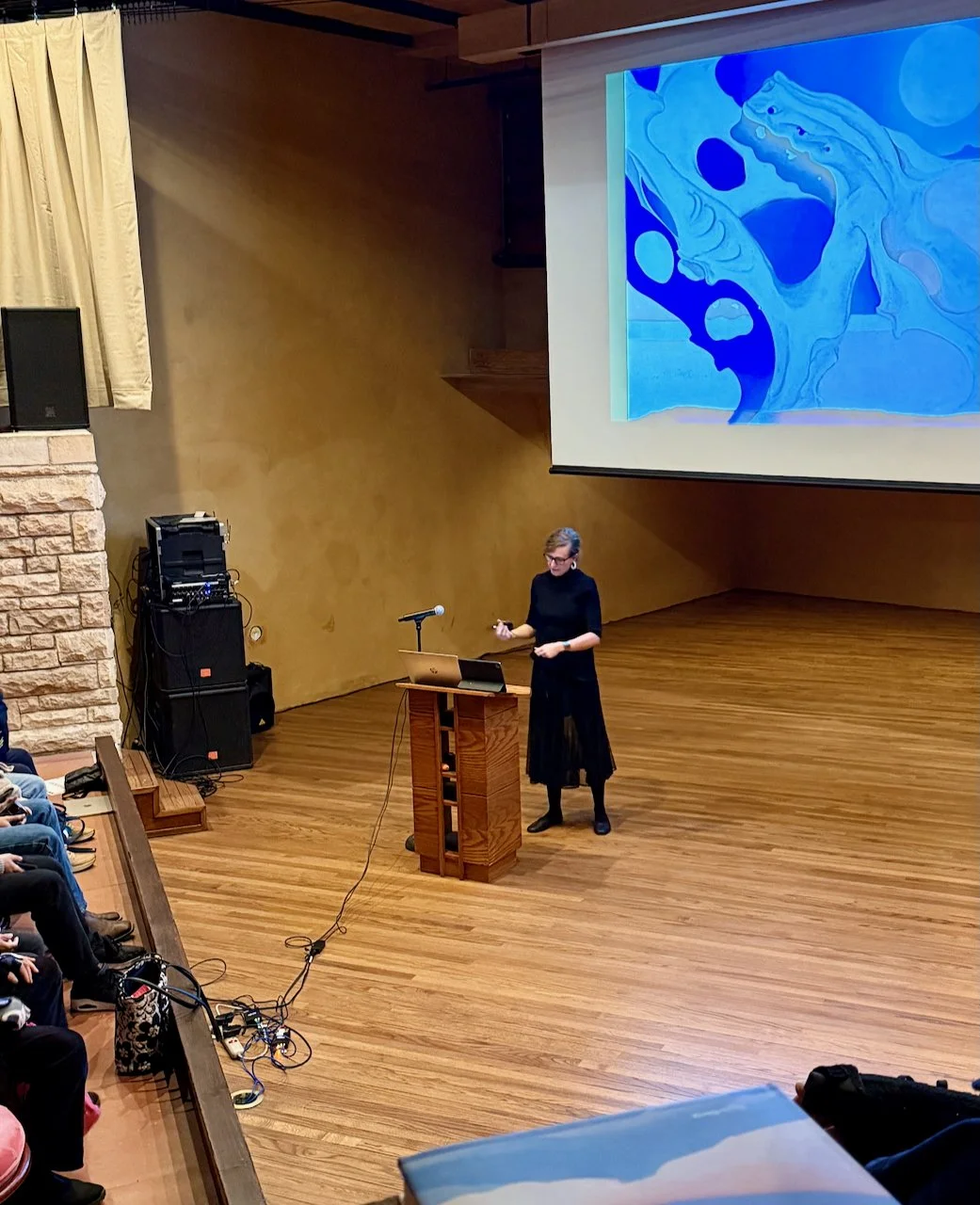
Lessons learned: the tech setup will fail in unexpected ways and your skirt will be less opaque than you remembered when you packed it.
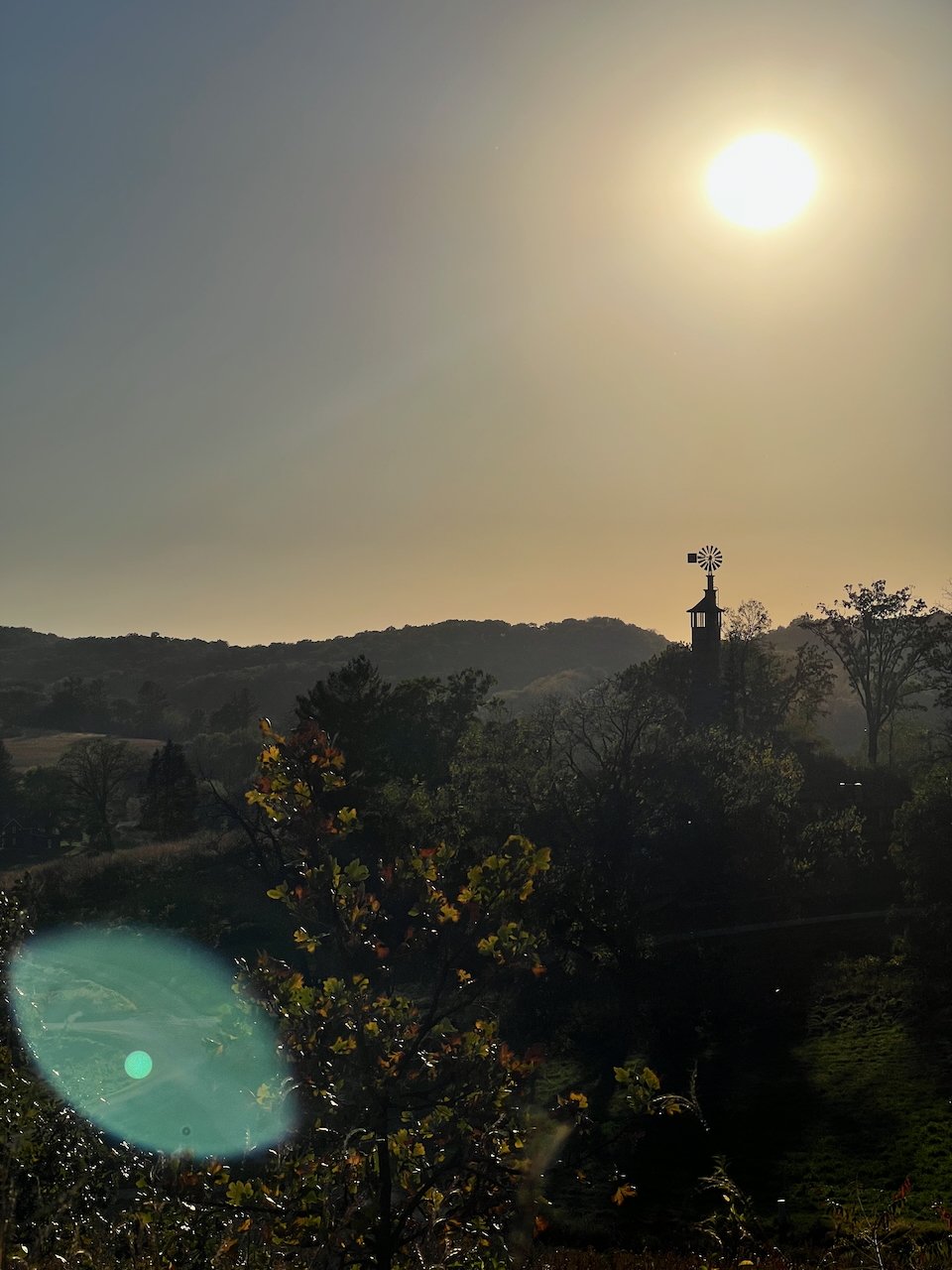
It’s a good windmill, Brent.